




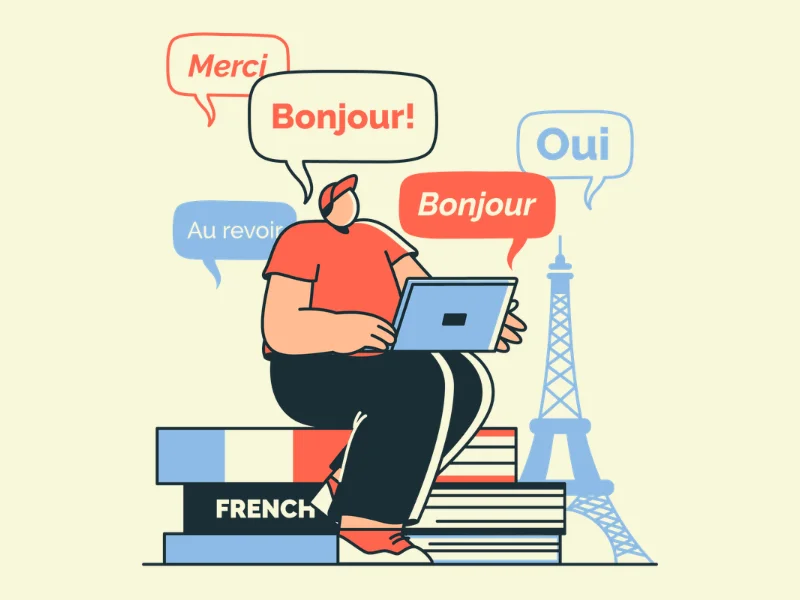
Learning how to introduce yourself is one of the first steps in speaking French. A simple introduction can help you start conversations with confidence. You do not need to know many words at first. Learning a few common phrases is enough to get started.
If you ever need to introduce yourself, these sentences will be useful. Therefore, here is how we are going to learn to introduce ourselves in French step-by-step.
For the easiest way to introduce yourself in French, understand this intro table first:
|
Situation |
French Phrase |
English Meaning |
|
Greeting |
Bonjour |
Hello / Good morning |
|
Evening Greeting |
Bonsoir |
Good evening |
|
Casual Greeting |
Salut |
Hi/Bye |
|
Say Your Name |
Je m'appelle [name] |
My name is [name] |
|
Say Where You Are From |
Je viens de [place] |
I come from [place] |
|
Say Where You Live |
J'habite à [city] |
I live in [city] |
|
Say Your Age |
J'ai [age] ans |
I am [age] years old |
|
Talk About Studies |
J'étudie le français |
I study French |
|
Talk About Work |
Je travaille comme [profession] |
I work as a [profession] |
|
Talk About Hobbies |
J'aime [activity] |
I like [activity] |
|
End Politely |
Enchanté(e) |
Nice to meet you |
|
Ask the Other Person |
Et vous ? |
And you? |
1. Start With a Greeting
The first part of any introduction is a greeting. Common French greetings include:
- Bonjour - Hello or good morning
- Bonsoir - Good evening
- Salut - Hi or bye
- Enchanté(e) - Nice to meet you
Bonjour works in most situations, while Salut is more casual.
For example:
Bonjour! Je m'appelle Ananya.
Hello! My name is Ananya.
2. Say Your Name
The most common way to introduce your name is:
Je m'appelle [your name].
My name is [your name].
For example:
Je m'appelle Rahul.
my name is Rahul
For beginners, 'Je m'appelle' is an easy phrase to practise.
3. Say Where You Are From
To tell someone where you are from, use:
Je viens de [place].
I come from [place].
For example:
Je viens d'Inde.
I come from India.
You can also describe your nationality:
Je suis indien.
I am Indian.
For a female speaker:
Je suis indienne.
I am Indian.
In French, nationality words can change depending on whether the person is male or female.
4. Tell Someone Where You Live
To say where you live, use:
J'habite à [city].
I live in [city].
For example:
J'habite à Mumbai.
I live in Mumbai.
You can combine it with your name:
Bonjour, je m'appelle Riya. J'habite à Mumbai.
This means:
Hello, my name is Riya. I live in Mumbai.
5. Talk About Your Age
French uses a different structure when talking about age.
You say:
J'ai 22 ans.
I am 22 years old.
Another example is:
J'ai 25 ans.
I am 25 years old.
Remember to use j'ai, not je suis, when saying your age.
6. Talk About Your Studies or Job
You can briefly mention your studies or profession.
For a student:
Je suis étudiant.
I am a male student.
Je suis étudiante.
I am a female student.
To say that you study French:
J'étudie le français.
I study French.
For work, you can say:
Je travaille comme ingénieur.
I work as an engineer.
You do not need to explain your entire background. One simple sentence is enough.
7. Mention Your Hobbies
Hobbies can make your introduction more personal.
Use:
J'aime [activity].
I like [activity].
For example:
J'aime lire.
I like reading.
J'aime écouter de la musique.
I like listening to music.
J'aime voyager.
I like travelling.
You can also say:
Pendant mon temps libre, j'aime lire.
In my free time, I like reading.
These phrases can help keep the conversation going.
8. End Your Introduction Politely
After sharing your basic details, end your introduction politely.
You can say:
Enchanté(e) !
Nice to meet you!
Or:
Enchanté(e) de vous rencontrer.
Nice to meet you.
You can then ask:
Et vous ?
And you?
This gives the other person a chance to introduce themselves too.
How This Intro Looks Like When We Pronounce Them in Example:
|
French |
English |
|
Bonjour ! |
Hello! |
|
Je m'appelle Riya. |
My name is Riya. |
|
Je viens d'Inde. |
I come from India. |
|
J'habite à Mumbai. |
I live in Mumbai. |
|
J'ai 22 ans. |
I am 22 years old. |
|
J'étudie le français. |
I study French. |
|
J'aime lire et écouter de la musique. |
I like reading and listening to music. |
|
Enchantée de vous rencontrer. |
Nice to meet you. |
|
Et vous ? |
And you? |
Pay Attention to French Pronunciation
Knowledge of vocabulary is only one part of speaking French. Proper pronunciation is important too. There are some French sounds which could seem strange to English or Indian language speakers.
The final consonant in French words is often not spoken. "Vous" would sound similar to “voo”, while "français" would sound something like "fron-say".
Do not worry about getting every sound perfect at the beginning. Instead, listen to native speakers and repeat short phrases. Practising complete sentences can help you develop a more natural rhythm.
Avoid Common Beginner Mistakes
Beginners often try to translate English sentences word for word into French. This can lead to mistakes.
For instance, whenever you are referring to your age, avoid saying Je suis 25 ans; instead, you should say J'ai 25 ans. Similarly, when mentioning your residence, use J'habite à, and for your origin, use Je viens de.
Learning these phrases as complete expressions can make them easier to remember. With regular practice, you will start using them without translating each word in your head.
Here is an example of where a Newby makes mistakes while talking in French.
|
Incorrect French |
Correct French |
Why |
|
Je suis 25 ans. |
J'ai 25 ans. |
French uses avoir when talking about age. |
|
Je suis de Kolkata. |
Je viens de Kolkata. |
Use Je viens de to say where you come from. |
|
Je vis à Kolkata. |
J'habite à Kolkata. |
J'habite à is a simple beginner-friendly way to say where you live. |
|
Je suis étudiant. |
Je suis étudiant / étudiante. |
The word changes depending on gender. |
Tips for Introducing Yourself in French
A few simple habits can make speaking easier:
- Start with short sentences.
- Practise speaking aloud every day.
- Learn phrases instead of isolated words.
- Pay attention to French pronunciation.
- Repeat common introductions until they feel natural.
- Listen to native French speakers to improve your accent.
- Try using your introduction in real conversations.
- Record yourself and listen for areas you can improve.
Most importantly, do not worry about making small mistakes. Speaking regularly helps you become more comfortable with the language. Even a few minutes of daily practice can help you remember common phrases.
Conclusion
Knowing how to introduce yourself in French provides an excellent starting point to begin having everyday conversations. Start by learning basic expressions like Bonjour, Je m'appelle, and J'habite à. After becoming comfortable with these, you can move on to adding information about yourself.
With regular practice and the right guidance, speaking French can become much easier. Online language skills can also help learners build their language skills through structured learning and regular practice.